Category: Beauty

Women in entertainment share their stories of abuse (National Domestic Violence Hotline, 1.800.799.3224)

By Angela Wilson | UAB Community Health & Human Services Program Intern
Keke Palmer is an established actor, singer, and television host. She made history by becoming the first and youngest African American woman to play Cinderella on Broadway.  Cassandra Ventura (Cassie) is a singer, songwriter, dancer, model, and actress. Both ladies have amassed millions of fans who adore their work and respect their craft. They are constant fixtures on social media, of achieved both fame and fortune, and in committed relationships. Keke has a four-month-old baby with boyfriend Darius Jackson and Cassie has 2 children with hubby Alex Fine. These two ladies seem to have a life that most would envy. But unfortunately, according to them, they have endured rocky moments: Cassie in a previous relationship with another well-known celebrity.

Keke Palmer sent shockwaves through the entertainment world in November of 2023 when she requested (and received) a temporary protection order and sole custody of her 6-month-old child with boyfriend Darius Jackson whom she alleged physically assaulted her. She also revealed pictures on Instagram that appeared to confirm these allegations.

Cassandra Ventura (Cassie), shocked the hip-hop world when she alleged physical and sexual abuse by Sean Love Combs, also known as Puff Daddy, P. Diddy, and Brother Love. Puff Daddy is very well-known in the entertainment industry for being a singer, songwriter, record producer, actor and philanthropist. Puff Daddy settled with Cassie a day after her civil lawsuit was filed for an undisclosed amount of money. Although settled in court, Cassie’s claims does shine a light on harsh realities and adverse experiences she endured while starting a career in the music industry. After spending years in darkness, Cassie has exclaimed her desire to speak up so that she could help other women who may also be in abusive relationships. Since her public allegations were made, three other women have come forward with accusations of physical and sexual abuse against Puff Daddy.

KeKe and Cassie’s resilience should be celebrated and their efforts to “speak up” are applauded by many. Their story is one of adverse experiences, but continues to provide HOPE for many who are following their journeys. For example, KeKe hosted the Soul Train Music Awards in November 2023, performing an emotional song called “Ungorgeous,” baring her soul and family challenges. KeKe has many projects in the works and is continuing to focus on her family. Cassie too is enjoying motherhood, her role as a wife to a loving husband, and continues her modeling career. They both are living models of encouragement for overcoming hardships in intimate partner violence (IPV).

According to the Domestic Violence Hotline, 3 out 10 women have experienced rape, physical violence, and/or stalking by a partner and reported it having a related impact on their functioning. Additionally, IPV affects more than 12 million people every year in the United States. Domestic abuse is never okay!  If you or someone you know is in an abusive relationship, there is help. The National Domestic Violence Hotline operates 24 hours a day, 7 days a week. You can call, send a text message, or start a chat. They offer care, support, and advocacy and can be reached at 1-800-799-SAFE (7233), or by texting “START” to 88788.

Hitting the Hot 100, checking STD stats, checking your STD status

Angela Wilson | UAB Community Health & Human Services Intern

Sexyy Red is the latest Hip-Hop sensation and cultural phenomenon.  She cemented herself as a mainstream artist with her break-out hit “Pound Town” and partnered up with Niki Minaj on the certified Gold hit entitled “Pound Town 2″, debuting at No. 66 on the Billboard Hot 100. Unfiltered, the rapper’s lyrics may be considered a bit “raunchy” for some listeners. Still, she has fans, many fans, amassing over 1.7 million followers on Instagram and is currently the opening act for mega-entertainer and rapper, Drake.  Often dawning pierced lips, eccentric hairstyles, and revealing clothes, Sexyy Red is a rising star in the rap and hip-hop genre. It appears many enjoy her message of sexual freedom, but some may also take issue with her messages, portrayal of Black women, or the way she discusses sexual experiences openly.

Sexy Red, whose real name is Janae Wherry, has been receiving tons of backlash lately after proclaiming herself “the raw dog queen” on Lil Yahty’s podcast. “Raw dog” is a saying that means “having unprotected sex.” She also revealed that she does not like condoms or latex and claimed that they make her private area smell. It did not take long for her comments to hit Facebook, Instagram, Twitter, and other forms of social media; with some disapproval and others claiming that she’s “keeping it real.”

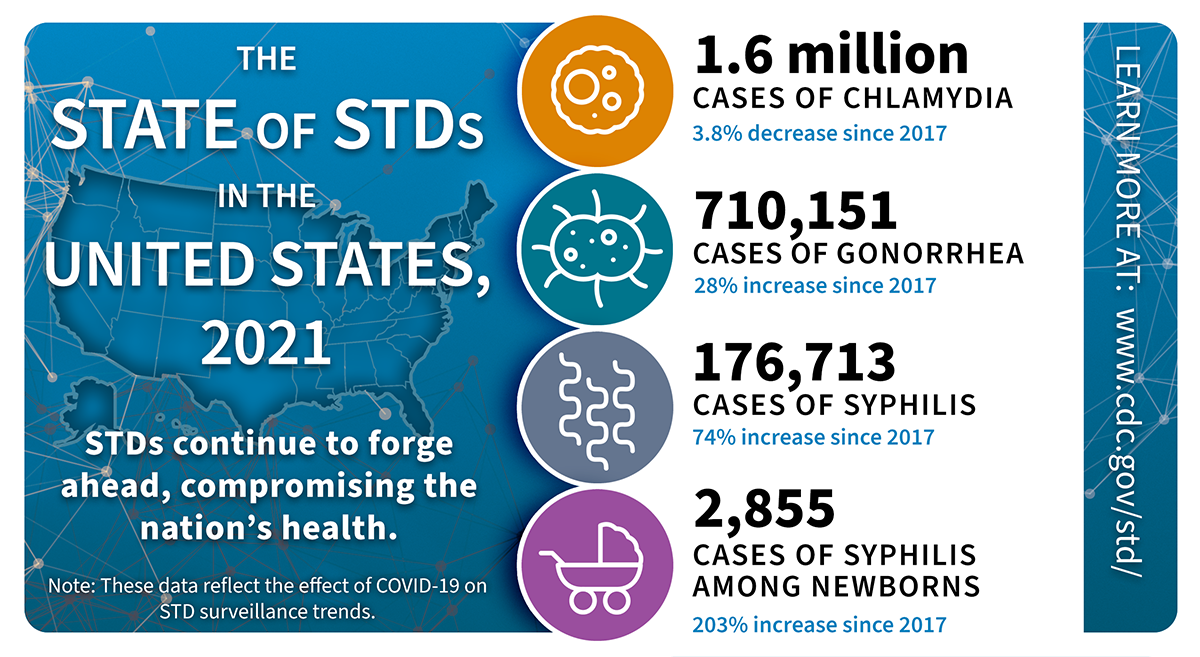
It is easy to understand the concerns about the some of the statements Sexy Red made in her interview. Still, it is important to raise awareness about some specific concerns if one chooses to engage in sexual activity. Check out the graphic from the Centers for Disease Control and Prevention (CDC) below regarding sexually transmitted diseases (STDs) in the United States.

Additionally, it is important to understand that consistent and correct use of latex condoms can drastically reduce the risk of gonorrhea, chlamydia, and trichomoniasis. Latex condoms can also reduce the risk of genital herpes, syphilis, and chancroid, working when a person’s infected area or site of potential exposure is protected (CDC, 2023). Check out the links with each sexually transmitted infection or disease (STI or STD) to learn the facts about each.

If someone has concerns about latex condoms, some condoms are made of other materials (i.e., polyurethane, polyisoprene, and nitrile) are great for people who have latex allergies or sensitivities. Still, these condoms may be slightly less effective at preventing STDs than condoms made from latex (Marfatia, Pandya, & Mehta, 2015).

If choosing to engage in sexual activities, health experts from the CDC and Planned Parenthood encourage individuals to consider the following tips:

For more tips and to learn more about protecting yourself during sexual activities, please check out the links above. Want to talk some more, check out our Facebook page here: @phame.us.impact.

References

Center for Disease Control and Prevention. (2023, September 5). U.S. STI Epidemic Showed No Signs of Slowing Down in 2021 – Cases Continued to Escalate. https://www.cdc.gov/nchhstp/newsroom/2023/STD-Surveillance-Report-2021-media-statement.html

Center for Disease Control and Prevention. (2023, September 5). How can I Protect Myself from HIV?. https://www.cdc.gov/hiv/basics/hiv-prevention/protect-yourself-during-sex.html

Marfatia YS, Pandya I, Mehta K. Condoms: past, present, and futureIndian J Sex Transm Dis AIDS. 2015;36(2):133–9. doi:10.4103/0253-7184.167135

Taking on Stereotypes About Black Women’s Hair

By Angela Wilson | UAB Community Health and Human Services Intern

Photo by Ogo on Pexels.com

It gets incredibly exhausting to dispel myths about the African American culture constantly.  It is even more tiring to have to defend your hair repeatedly.  As more black women become educated, enter the workforce, and become entrepreneurs, many still defend their hair, especially if they wear it in natural styles like afros, braids, Bantu knots, and locs.  In recent years, Black women have increasingly embraced wearing their natural hair and have abandoned using perms and relaxers.  Some say this could be viewed as the Black woman’s revolution, and even though Black women have been celebrated and (mostly) accepted for their decision to go all-natural, it is still an ongoing battle to combat some stereotypes associated with Black hair. 

So, what are some of these stereotypes associated with Black women’s hair? Well, there is the myth that Black women never wash their hair.  This seemingly stems from the fact that most Black women’s hair is naturally dry, making it more vulnerable to breakage.  As a result, they may opt to wash their hair less frequently to avoid stripping it of its natural oils.  Another stereotype is that Black women’s hair cannot grow long, which is why Black women wear hair extensions and wigs.  Although race seems to be a factor in Black women’s hair growth, several other factors, including genetics, nutrition, and age, also play a role.  On average, a Black woman’s hair grows approximately 4 inches a year (one inch shorter per year than White women’s), but due to the coarse texture of Black hair, the length does not show unless the hair is straightened.  As far as Black women wearing weaves and wigs, most Black women wear them to provide a protective styling option, save time, and explore more hair options like different hair colors, not because their hair will not grow. 

These stereotypes are not exhaustive; unfortunately, much more must be debunked.  Hopefully, as more people educate themselves with facts and knowledge, Black women can finally escape the many stereotypes about their hair.

References

Alcindor, et al. (2021). PBS.org. How Hair Discrimination Impacts Black Americans in Their Personal Lives and Workplacehttps://www.pbs.org

Scholars Strategy Network. (2021). What’s Hair Got to Do with It? Black Women’s Bodies and the Traditional Look of Success in American Politics. https://scholars.org.

Hair Straighteners: What you NEED to know

Reginia Dodson | UAB Community Health and Human Services Intern

Photo by Dellon Thomas on Pexels.com

The use of alleged natural products to straighten African American women’s hair seems somewhat formidable in nature but also seems important knowing the composition of hair and its structure that deems safe. The natural products used to straighten the hair are an alternative that may seem safe because of the term “natural” being used. The bottom line is that they all contain duplicate chemicals that will eventually become formaldehyde when heated. Most treatments won’t last long, meaning that after about 6 months the results will start to wash out, yet they claim to be free of harmful chemicals. Certain types of hair straightening methods may not cause cancer to most females but in turn, it will cause damage to the hair that is irrespirable and cause hair loss because the follicle is severely damaged. If the hair begins to grow back it will look drastically different from the straightened hair therefore meaning that another hair straightening must be applied to look coherent with the growth that is new.

Permanent hair straightening doesn’t mean it last forever. The results of hair straightening vary widely and are dependent upon the hair type and texture, meaning the life cycle of hair determines how long it will lay. Using hair straightening products is solely up to the consumer and what they are willing to sacrifice in order to get that look or to keep up with the current trend that’s acceptable or cool. Hair weave and extensions have become a healthier substitute or alternative as opposed to hair straightening products and chemicals because they need no chemicals to maintain the straight-hair appeal (Gathers, et.al,2014)

The National Institute of Health reported in 2022 that African American women had an increased risk of getting hormone-related cancer from applying products using hair straightening chemicals and dyes. The cancer most prevalent in African American women from this study was found to be uterine cancer. The frequency of cancer from using these hair straightening products was double that of their counterparts. The terms used to identify, and disguise these cancerous product sources are commonly known as perms or relaxers. African American women are more susceptible to these cancers from extended use over a long period of time because these treatments tend to straighten the hair present and not the hair being grown such as “new growth.”

There are several types of hair straightening methods:

  • Professional hair straightening (permanent) Salon appointment usually takes about two hours dependent upon the length of hair ($50)
  • At-Home hair straightening relaxing kits that are chemical based with the same results as the salon visit ($15)
  • Keratin hair straightening and Brazilian Blowouts straighten hair similar to other hair straightening methods but require several salon visits for completion of the application and last at least 3 to 5 months before a redo ($150)
  • Japanese Therma Straightening known as an “acid perm” requires 5 to 6 hours at a salon but lasts up to 6 months. This method uses a neutralizer that causes the hair to lock into a new shape ($200-800)
  • Hair Rebounding converts hair that is curly and wavy to straight in about 2 to 4 hours. This process uses formaldehyde which is a known cancer-causing agent but is able to straighten the hair much faster than all the other processes. The cost varies from ($250-1000) (Watson, 2023)

The most important thing to remember any time you are using products is do your research! Find a technique that is both affordable and safe for you.

References:

Gathers, C.R. & Mahan, M.G. (2014, Sep) African American Women, Hair Care, and Health

Barriers. https://www.ncbi.nlm.nih.gov/pmc/articles/PMC4174916/

Watson, K. (2023, May) Everything You Want to Know About Permanent Hair Straightening. https://www.healthline.com/health/beauty-skin-care/permanent-hair-straightening

Dear Black Girl & Dear Black Boy: Interview with author Dr. Cheri Langley

By Angela Wilson | UAB Community Health & Human Services Intern

Photo by Jairo David Arboleda on Pexels.com

I had the privilege of interviewing the author of Dear Black Girl and Dear Black Boy.  Dr. Cheri N. Langley wrote these books that brings visibility, perspective, and awareness to some of the issues that impact African American boys and girls.  These short, colorful poems help children process some of the racial tensions that they are facing in society.  Dr, Langley further acknowledges that being a black boy in America can carry anxiety and she offers advice on how to engage with law enforcement that could possibly save lives.

In Dear Black Girl, Dr. Langley approaches the issues of racism, sexism, and misogynistic stereotypes experienced by young African American girls. This literature is to invoke conversation and facilitate a healthy dialogue between young black girls and their parents and caregivers.  The language in both books is in poetry form with pictures that are captivating. Dr. Langley does an outstanding job with describing the life of young African American children and commanding their attention to these stories. Her dedication is inscribed at the beginning of the story where she assures her audience that they are loved, and their voices are heard. She brilliantly puts discussion questions at the end of the books that parents can use to help their children understand the contents and purpose. These books serve to bring truth, facts, and compassion to African American children who may not have a voice. Dr. Langley feels that it is important for children of other races to read the book so they can see the lives of their African American peers through their lens.

Dr. Cheryl Langley’s inspiration for Dear Black Boy came from watching the video of George Floyd. Being the mother of two black sons, she said she could not just “look away” from such a horrific incident and felt the need to write to reach little black boys who may be crying out for help.  Dr. Langley is an advocate for underserved and minority populations and has been heavily involved with research involving HIV and AIDS, and sexually transmitted infections awareness and prevention.  She uses her background in behavioral sciences and her work through novels and poems to help facilitate her journey to create positive change, protest injustices, and increase dialogue regarding systemic inequality.  

If you are interested in purchasing either of these works, please check out: https://www.amazon.com/stores/Dr.%20Cheri%20N%20Langley/author/B097QQL3RW

References:

Langley, C. (2023). Dear Black Boy. Dear Black Girl. Langleyresearch.org

Your Hair Your Health

By Terrie Johnson | UAB Community Health & Human Services Intern

Photo by TUBARONES PHOTOGRAPHY on Pexels.com

Black women have an intricate emotional attachment to their hair. This inclination stems from the aspects of what hair represents to them. In most cases, it is not taken just as an extension of parts of the body, but as a reflection of one’s moods. For most Black women, hair is a symbol of identity. Foundationally, it provides bearings to identify as a strong individual with a critical cultural background. To most individuals from this population segment, hair is a treasure that cannot be ignored. As such, care and attention are given to ensure that it signifies something relevant that runs much deeper.

In the context of appreciating their beauty, most Black women consider their hair an extension of their physical outlook. Thus, it represents an intricate aspect regarding their emotional well-being. Often, hair is taken as part of expressing one’s mental state. It is considered a direct mirror of a Black woman’s mood (Vice Media Group, 2022). The perfectly made hair is perceived as a revelation of one’s happiness and state of pride in who she is and represents. Among Black women, hair is viewed as a connecting element (Vice Media Group, 2022). It brings women together to share their experiences and perspectives concerning society. Therefore, hair’s relevance transcends its aesthetical value.

The time Black women take to wash and care for their hair symbolizes its criticality and the reason behind the emotional attachment. Despite the amount of time required to make it perfect, most Black women do not mind. This inclination is based on hair being a representation of the ancient hairstyles and rituals imported from Africa, and some developed in varied locations following slavery. As such, when Black women braid their hair, they feel an emotional connection to their ancestral past. Thus, based on the above reasons, hair remains a relevant part of Black women’s existence.

Reference

Vice Media Group. (2022). Braids, wigs, & wash day routines: 4 Black women on the meaning behind their hair ritual. Refinery29. Retrieved from https://www.refinery29.com/en-us/black-women-hair-routines-meaning

Dying To Be Perfect

Angela Wilson | Intern UAB School of Education | CHHS

Photo by Paras Griffin/Getty Images

Jacky Oh was a Beautiful, talented mega-influencer, model, and socialite who seemed to have everything.  She was a YouTuber, an entrepreneur of a lip gloss line, and a regular star on the hit comedy and cultural phenomenon, “Wild ‘N Out”.  She had amassed an Instagram following of more than a million people and had three beautiful children with her longtime partner, comedian and rapper, DC Young Fly.  Unfortunately, at just 32 years old, Jacky Oh, whose real name is Jacklyn Smith died. 

The vivacious beauty posted on her Instagram page that she was going to have a “mommy makeover” and that she would reveal the results of her procedure on her YouTube channel.  She seemed very excited about the possibility of improving her body, by tightening up the problem areas just months after giving birth to her son. She and her doctor, Dr. Zachary Okhah, were all smiles standing next to each other while flirtatiously piquing the interest of her fans. The publicity seemed to be destined for a promotional win and money maker for both of them, but something went terribly wrong. 

According to the American Society of Plastic Surgery, a mommy makeover can include targeting more than one area of a woman’s body,. Often the surgery of choice for women who have noticed significant changes in their bodies as a result of gaining and losing weight, breastfeeding, and other physical changes during motherhood. The typical problem areas are the breasts and the abdomen.  The breasts began to loose shape after breast-feeding, and the abdominal muscles, tissues, and skin that stretch during pregnancy to accommodate the fetus, may not snap back after giving birth. This leaves women with layers of excess abdominal skin usually accompanied by unsightly stretch marks.  If you are in the entertainment business and your revenue is generated based on how good you look, or how fit your body is, it is easy to see why Jacky Oh decided on a mommy makeover. 

A mommy makeover may consist of breast augmentation, a breast lift, a tummy tuck, circumferential abdominoplasty, and liposuction. It may seem like an easy, quick way to get your pre-pregnancy body back, but there are several risks involved. These risks include infection, bleeding, hematoma, unfavorable scarring, necrosis, cardiac and pulmonary complications, persistent pain, contour deformity, fat embolization, anesthesia risks, and even death.

While speculation is running rampant about the exact cause of death of Jacky Oh, the only thing that is certain is that 3 children will grow up without their mother, millions of fans will be without their shining star, and a loyal man be without his partner.  I cannot help but ask myself, is having cosmetic surgery worth the risk?

References

America Society of Placstic Surgeons. (2023). Mommy Makeover Risks and Safety. https://www.plasticsurgery.org.

Brito, Christopher. (2023, June 2). Jacky Oh, Wild ‘N Out Cast Member, Dead at 32.  https://www.cbsnews.com.

I am Not My Hair

By Tan Walker | Community Health and Human Services Intern

In today’s society, glorifying unhealthy and unrealistic expectations makes us beautiful. It is easy to focus on appearance rather than character. Women, especially black women, have to work more than most to attain the world’s idealistic view of beauty.

The Afro hair texture has been the epitome of a black woman’s life for centuries. As far back as the slave trade, Africans were forced to abandon their links and connections to their natural hair to simply strip away any cultural identity or tribal heritage (Black hair and an unjust society, 2021). However, this has not stopped Black women from embracing their natural tresses.

From the infamous “fro” to hair wraps to braids, Black women continue to embrace their natural hairstyles to help express who they are, and to show the evolution of empowerment and Black culture over time.

As a community, we must speak power into our young black girls and remind them that their natural hair is beautiful until they feel it themselves, and that their natural hair doesn’t define who they are. 

Black hair and an unjust society. (n.d.). Retrieved April 17, 2023, from https://www.edi.nih.gov/blog/communities/black-hair-and-unjust-society

A Note of Love to My Wife Khalia: Thank You Sweetheart

My dearest Khalia,

Thank you for your love.

Thank you for being patient with me. Sometimes my ways are not your ways and your ways are not mine, but you choose to love me through the tension.

Thank you for being kind to me. I realize there are times I am unpleasant to be around, but you choose to love me with your gentleness.

Thank you for being generous with me. I realize there are times between us that inspire resentment, but you choose to pursue goodwill in our relationship.

Thank you for diminishing my faults, remaining down-to-earth, and being civil and polite. I realize there are times I come off rude or high-and-mighty, but you choose to not be irritable with me and forgive my wrongs.

Thank you for being fair with me. I realize there are times where your sacrifice or compromise is not celebrated, but you choose to exercise truth in a respectful manner.

Thank you for not giving up on me, not losing faith in me, remaining hopeful with me, and enduring life’s circumstances with me! Thank you for being a loving wife to me!

Your Husband,

Larrell L. Wilkinson

Reflecting on 2020: The @Home Haircut while in Quarantine


No doubt, 2020 was a hard year! There were many tragic circumstances (I won’t list them in this lighthearted post) that transpired through the year. Life changed for many of us. As I type this reflection, it is hard for me to remain cheerful because the year was filled with many challenges for the nation, there were many struggles in local communities, and many hardships for individuals close to me (myself included). Still, in this posting, I will choose to reflect on a lighter side of life. So here it goes, among the many reflections I have about 2020, at least one of those is the Quarantine Haircut. Now, it may not be what you think…I don’t have a horror story. I am bald, so I am good! And, I know that we are to “not worry…about your body, what you will wear…is not life more than food, and the body more than clothes?” (Matthew 6:25, NIV). So, we shouldn’t worry about haircuts? Right? Well, I do want my son to look good, but…$15 – $20 per haircut. I mean real talk; he is 3 years old. He doesn’t like to sit still and sometimes he cries when I cut his hair, especially when he was younger. Plus, that is low end $180 to high end $480 a year. We’re on a budget, so yes, I have and will continue to cut his hair (at least in the short term)!

The reason why I can appreciate 2020 is because so many other parents did the same thing. Many parents (& adults) got their haircut at home, imperfections or haircut fails and all! I won’t comment about the stress that the women in my family experienced. That is another post for another day…or never! For me, I didn’t feel that fatherly guilt knowing my son didn’t have the “tightest fade” or the coolest new design! Everybody did what they had to do, and the world kept on spinning! So, parents, are you going back to taking your son to the barbershop? Or, are you pocketing the haircut money and putting the money away in savings account, using the money to invest, or placing the money for your vacation fund?

At least for the time being, there will be no strong tape ups (fades) for my son [although I will start to practice] and sometimes his hair line is a little crooked (I know, but it grows out). But there is also, no 20 – 30-minute drive to the “shop” and then another 20 – 30 minutes back home; no appointments or wait times for the “chair” (the wait can be so long); and we continue to place the cost savings into other budget areas for the family. Plus, we still aren’t going much of anywhere…anyways! And although we aren’t supposed to worry about how we look so much , my son is still very handsome!