Category: Encouragement

Pete Davidson – It’s OK when you are not OK

Angela Wilson | UAB Community Health & Human Services Intern

Photo: Saturday Night Live @NBCSNL on Instagram

Pete Davidson is a comedian, actor, and writer.  He made us laugh for many years while performing outrageous skits on the late-night series, Saturday Night Live, but America’s funny man has checked into a rehabilitation facility, and it is no laughing matter (Drillinger, 2023) . Davidson has always been transparent about his diagnosis of post traumatic stress disorder, (PTSD) and borderline personality disorder. Sometimes we think that entertainers are exempt from mental health issues, but Davidson is the epitome of that not being the case.  Pete Davidson is one of millions of Americans who suffer from mental health disorders, partially brought on by the death of his father in the September 11, 2001 attacks.

Like Pete, many Americans need therapy to help protect their mental health, and according to Cindy Sharp, a local Clinical Social Worker/ Therapist, who specializes in trauma, anxiety, and depression, there has been a spike in people seeking mental health services. Worry, grief, self-doubt, anxiety, losing loved ones, and divorce are things that we all go through at some point in our lives. However, due to the stigma attached to mental health, we often do not seek out the help that we need. People end up suffering in silence as they struggle with day-to-day living. Most of us will go to a doctor when our physical body is in pain, but when our mental state is hurting, we do not put forth the same energy. We need to normalize and destigmatize taking care of our mental health.

Mrs. Sharp’s practice focuses on a holistic approach to therapy.  She feels passionate about providing an environment where people with mental health issues can feel safe and supported so they can embrace positivity and begin the journey to heal.  She is just one of many therapists who can help you explore your troubling issues. 

If you are struggling with your emotions, thoughts, or behaviors and feel that your mental health is at risk, please seek help! It is OK so say you are not OK.  Pete Davidson realized he was not ok and took the necessary steps to get help. How many others are willing to do the same?

References

Drillinger, M. (2023). Pete Davidson Checks Into Rehab for PTSD, Other Mental Health Issues. Healthline. https://www.healthline.com

Dear Black Girl & Dear Black Boy: Interview with author Dr. Cheri Langley

By Angela Wilson | UAB Community Health & Human Services Intern

Photo by Jairo David Arboleda on Pexels.com

I had the privilege of interviewing the author of Dear Black Girl and Dear Black Boy.  Dr. Cheri N. Langley wrote these books that brings visibility, perspective, and awareness to some of the issues that impact African American boys and girls.  These short, colorful poems help children process some of the racial tensions that they are facing in society.  Dr, Langley further acknowledges that being a black boy in America can carry anxiety and she offers advice on how to engage with law enforcement that could possibly save lives.

In Dear Black Girl, Dr. Langley approaches the issues of racism, sexism, and misogynistic stereotypes experienced by young African American girls. This literature is to invoke conversation and facilitate a healthy dialogue between young black girls and their parents and caregivers.  The language in both books is in poetry form with pictures that are captivating. Dr. Langley does an outstanding job with describing the life of young African American children and commanding their attention to these stories. Her dedication is inscribed at the beginning of the story where she assures her audience that they are loved, and their voices are heard. She brilliantly puts discussion questions at the end of the books that parents can use to help their children understand the contents and purpose. These books serve to bring truth, facts, and compassion to African American children who may not have a voice. Dr. Langley feels that it is important for children of other races to read the book so they can see the lives of their African American peers through their lens.

Dr. Cheryl Langley’s inspiration for Dear Black Boy came from watching the video of George Floyd. Being the mother of two black sons, she said she could not just “look away” from such a horrific incident and felt the need to write to reach little black boys who may be crying out for help.  Dr. Langley is an advocate for underserved and minority populations and has been heavily involved with research involving HIV and AIDS, and sexually transmitted infections awareness and prevention.  She uses her background in behavioral sciences and her work through novels and poems to help facilitate her journey to create positive change, protest injustices, and increase dialogue regarding systemic inequality.  

If you are interested in purchasing either of these works, please check out: https://www.amazon.com/stores/Dr.%20Cheri%20N%20Langley/author/B097QQL3RW

References:

Langley, C. (2023). Dear Black Boy. Dear Black Girl. Langleyresearch.org

John Mulaney’s Battle with Addiction – Turning Darkness into Laughs

Amanda Benko | UAB School of Education Intern – Community Health & Human Services

John Mulaney is a popular stand-up comedian who has famously used his difficult past experiences as the subject of much of his routine, which includes a new relationship, birth of his son, and most notably addiction to cocaine, alcohol, and prescription medications. Most fans are aware of Mulaney’s past issues with drugs and alcohol, shedding light on his sober life and turbulent relationship with narcotics. When you watch Mulaney’s comedy, you’ll see a courageous man whose comedy is rooted in his personal experience.

Drug-related deaths accounted for over 109,000 US deaths in 2021 according to the NIH. Statistics include the fact that just in the last year, over 9.2 million people over the age of 12 admitted to using opioids (Substance Abuse and Mental Health Services Administration (SAMHSA), 2023). Drug abuse and addiction are anything but funny. If you are like me and have lost friends and loved ones to the disease of addiction, you certainly understand there is nothing comical about it. This is an epidemic the White House has attempted to tackle, along with the medical community, law makers, and countless civilians. Mulaney makes jokes about how absurd he behaved on drugs, not about addiction itself.

He publicly thanks those who were there and those who have had a hand in his intervention and recovery. As most addicts know, recovery is a journey; and Mulaney is still here making us laugh because his friends cared enough to step in (with help of professionals). Watching his show, the part of his act that stood
out most were the words of Mulaney’s friend, actress Natasha Lyonne. When he tells this story, he is not going for a punchline, he is getting vulnerable about how bad things were. Though not a direct quote, the message stuck with me. Lyonne: Johnny, You gotta go to rehab honey. Your life is in shambles, your career is in shambles. I know you think going to rehab would be embarrassing, but the way you’re living right now is embarrassing. Once you’re out, you can chain-smoke around the streets of New York like you’re the g*d-damn Bob Fosse of your generation. We can walk around dreaming big dreams, like we’re high as a kite; but instead, you’ll be alive, and we’ll be sober together. Mulaney credits Lyonne’s words for being the final straw helping him commit to rehab. His friends saved his life, and because of them, he is still here entertaining us all. As a fan, I am grateful.

If you want to hear more, check out “Baby J” on Netflix, where Mulaney gives his personal account.

If you or someone you know is battling addiction, please call 888.844.9121 for help, or reach out to Narcotic Anonymous at 818.773.9999 or visit na.org.

References: 

Carcieri, R., & Johnston, C. (2022, March 21). John Mulaney’s “from scratch” successfully tackles heavy issues with Grace. The Brown Daily Herald. https://www.browndailyherald.com/article/2022/03/john-mulaneys-from-scratch-successfully-tackles-heavy-issues-with-grace

Grebenyuk, Y. (2023, May 4). Everything John Mulaney has said about drug addiction, recovery. Us Weekly. https://www.usmagazine.com/celebrity-news/pictures/everything-john-mulaney-has-said-about-drug-addiction-recovery/

Substance Abuse and Mental Health Services Administration (SAMHSA). (2023, January 4). Samhsa announces National Survey on Drug Use and Health (NSDUH) results detailing mental illness and substance use levels in 2021. HHS.gov. https://www.hhs.gov/about/news/2023/01/04/samhsa-announces-national-survey-drug-use-health-results-detailing-mental-illness-substance-use-levels-2021.html

U.S. Department of Health and Human Services. (2023, March 31). Drug overdose death rates. National Institutes of Health. https://nida.nih.gov/research-topics/trends-statistics/overdose-death-rates

The United States Government. (2022, April 21). Fact sheet: White House releases 2022 National Drug Control Strategy that outlines comprehensive path forward to address addiction and the overdose epidemic. The White House. https://www.whitehouse.gov/briefing-room/statements-releases/2022/04/21/fact-sheet-white-house-releases-2022-national-drug-control-strategy-that-outlines-comprehensive-path-forward-to-address-addiction-and-the-overdose-epidemic/

Lizzo Is PHAT and Fed Up! Is There Any Kindness on Social Media?

Angela Wilson | Intern UAB School of Education | CHHS

Photo by Pixabay on Pexels.com

Is There Any Kindness on Social Media?

Melissa Viviane Jefferson, also known as Lizzo, is a talented singer, songwriter, rapper, and actress.  She is a trained flutist and has cemented herself in history by playing a crystal flute that President James Madison once owned at a concert in Washington, D.C.  She has won four Grammy Awards, two Soul Train Awards, and a Billboard Music Award.  With over 13 million Instagram followers, there is no denying that Lizzo is a hip- hop and cultural icon. But with all her wealth, success, and fans, Lizzo is ready to call it a quits.  She admits to being fat and she (usually) proudly displays her body in skimpy, revealing outfits, but not without social media trolls reminding her that she is overweight.

One would think that having a voice and stage presence as large as Lizzo’s, she would be somewhat shielded from mean spirited people who seem to get joy from name calling. Unfortunately, this is not the case.  Lizzo is constantly fat shamed because of her body.  She posted to her Twitter account (in part), that she was close to giving up and quitting because of all the name-calling she receives.  She concluded that the love she receives does not outweigh the hate.  So here we are (seemingly) on the cusp of losing one of the most influential hip-hop icons of our time, all because of a lack of kindness and compassion from the social media community.

Lizzo’s experience is just a small sample of a larger issue that is impacting millions of Americans. As our world leans more toward innovative technology and digitalization, we are seeing an increase in people being targeted by online bullying and offensive name-calling.  According to The Pew Research Center (Vogels, 2021), 41% of adults have experienced online harassment, and women are more likely than men to be victims.  While some perpetrators perceive cyberbullying as harmless fun, the effects of cyberbullying are serious. Victims of online bullying may experience feelings of distress, increased feelings of mood swings and depression, insomnia, low self-esteem, and even suicide.   So, while Lizzo’s platform brings visibility to this ongoing issue, there is a significant amount of work to be done to help alleviate it, and that work starts with each of us. As social media users, we need to get involved and actively promote a safe, supportive, and welcoming online environment for people being bullied.  There are no bystanders when it comes to cyberbullying and harassment. So, the next time you are on Facebook, Instagram, or any other social media platform, and you see someone being cyber-bullied, will you interject with kindness and be a part of the solution, or be a part of the problem?

References

Cuncic, A. (2022). Verywellmind. The Psychollogy of Cyberbullying. https://www.verymind.com.

Vogels. E. (2021). Pew Research. The State of Online Harassment. www.pewresearch.org.  

Michael Leon- From Ghana to Michigan

Angela Wilson | Intern UAB School of Education | CHHS

Photo by Asiama Junior on Pexels.

Michael Leon is a 22-year-old extraordinary athlete at the prestigious Ivy League University of Michigan. He has achieved impeccable stats while participating in the University of Michigan Men’s soccer program.  As a freshman, he started in 3 of the 12 games he played in and achieved a season -high 74 minutes at Oakland. His sophomore year would be equally impressive as he managed to log 84 minutes on the pitch shortly after recovering from a back injury. He has won Allstate and first-team All-star several times and has traveled internationally for training with youth academies. With such a stellar athletic resume, he has a promising future with encouraging prospects.  But this modest athlete is not only thinking about how he can make the future better for himself but also wants to make things better for others.

Michael Leon comes from humble beginnings. He was born and raised in Accra, Ghana, and has dreamed of being an athlete ever since he was ten. His love, tenacity, and passion for soccer helped to propel him from his native land to broader horizons. He played ball in Europe and subsequently moved to America to further his education and dreams.  After attending The Hotchkiss School in Connecticut and becoming one of the region’s top soccer players, Michael Leon committed to The University of Michigan, where he continues to deliver dynamic performances on and off the soccer field.

Remembering his earlier life in Ghana, Michael Leon is determined to make a difference.  He established the Michael Leon Project and partnered with The Uniform Funding Foundation (TUFF) to help provide equipment and uniforms to youths in Ghana.  Adam Shibley, the founder of TUFF, created the non-profit organization to help underserved youth sports teams acquire sports gear. Michael Leon approached him with the idea of providing these items to children in his homeland.  Earlier this year, Michael Leon and Adam Shibley traveled to Ghana and hand -delivered sports equipment to children at Israel Park in Ghana.  Michael Leon is not just a stand-out athlete. He is a compassionate human being who wants to be a role model for his community and provide children with the inspiration and motivation they need to chase their dreams.  Although Michael Leon is still pursuing his degree at the University of Michigan, it is almost certain that he will achieve more academic, professional, and philanthropic accomplishments.

References

Sigal, Jonathan. (2019). Recruiting: Hotchkiss Forward Michael Leon Commits to Michigan. https://www.nesoccerjournal.com.

The Uniform Funding Foundation. (2018). https://gettuff.org

Reflecting on purpose when choosing close friends

By Larrell L. Wilkinson | PHAME-US Campaign

Photo by Mauru00edcio Mascaro on Pexels.com

It has been said, “birds of a feather flock together.” I heard the wise saying growing up, especially in my teen years. I would see the saying on inspirational posters or hear it from family members and/or church leaders…particularly when being encouraged to stay away from individuals that may have been troublemakers. As the admonishment would go, “avoid hanging out with (insert first name) person, else you may end up in trouble like them. Remember, “birds of a feather flock together.” I know it seems so cliché, but coming back around to this quote many years later, I will acknowledge that the friends we have around us, particularly our closest friends, will more than likely influence the direction of our life. Our closest friends are likely a significant ingredient in our life’s recipe for successfully accomplishing our goals. So then questions arise like, “what goals do I have for my life” and “how should I determine who I let into my closest friend circle?

I recently had the opportunity to reflect on the process of choosing people in support of living out purpose while listening to the Bible. In Acts of the Apostles 1:12-21 (NLT), the apostles are meeting to chose another person to become a witness with them to the resurrection of Jesus. The apostles were looking for a person who would be trusted with leading in the Gospel and joining them in the innermost circle of the work to be done. Much like friends with different life experiences, the apostle’s relationships were lets say,…very human. And when it came to choosing from among people in their network, Acts of the Apostles 1:24 suggests that the men “prayed” about the hearts of the men to join them in the inner workings of the ministry. Hmmm, praying about who I should let into my closest network of people to join me in my most important works of life. Outside of my wife, I hadn’t much thought of that.

When it comes to making friends, we are told to associate higher (associating with people in a higher social status than your current position), choose friends with similar values and/or goals to your own, or choose friends that balance your strengths/weaknesses. All of this is good advice. Additionally, let’s acknowledge that in order for us and our flock to soar towards our purpose in life, it doesn’t hurt to pray about and for the people coming into or already in our lives. Perhaps we should consider talking through (vetting) and praying with trusted people already in our lives about individuals who may join our circle? Sound too intrusive? Sound too clique’ish? What if being intentional about the type of individuals joining us on our life’s journey and mission was a key ingredient to our success? I get it. Honestly, it feels a little uncomfortable to type. However, as I travel along the lifecourse, I’ve had many good and not so good experiences.

The best contributors to my continued evolution in life have been the ones that I know God has blessed me with encountering. God has placed a great variety of people from many different backgrounds and experiences in my life to help me along the way. Sometimes I prayed and the person came, other times I met the person through a program, in school, through work, etc. and later recognized that God sent them. Overall, we seldom go wrong when we have around us, people who are positive individuals, supportive of overall health, seeking to live out a positive purpose, and willing to work as a support with you and others toward common positive goals. We’ll show love to many people and will likely have a network of people around us. There are a lot of people out there from which to choose our closest friends, so in deciding, let’s choose to be intentional and consider the power of prayer as well. It doesn’t hurt and furthermore, the intentionality and prayer may be the difference in making decisions that have lasting benefit to our lives.

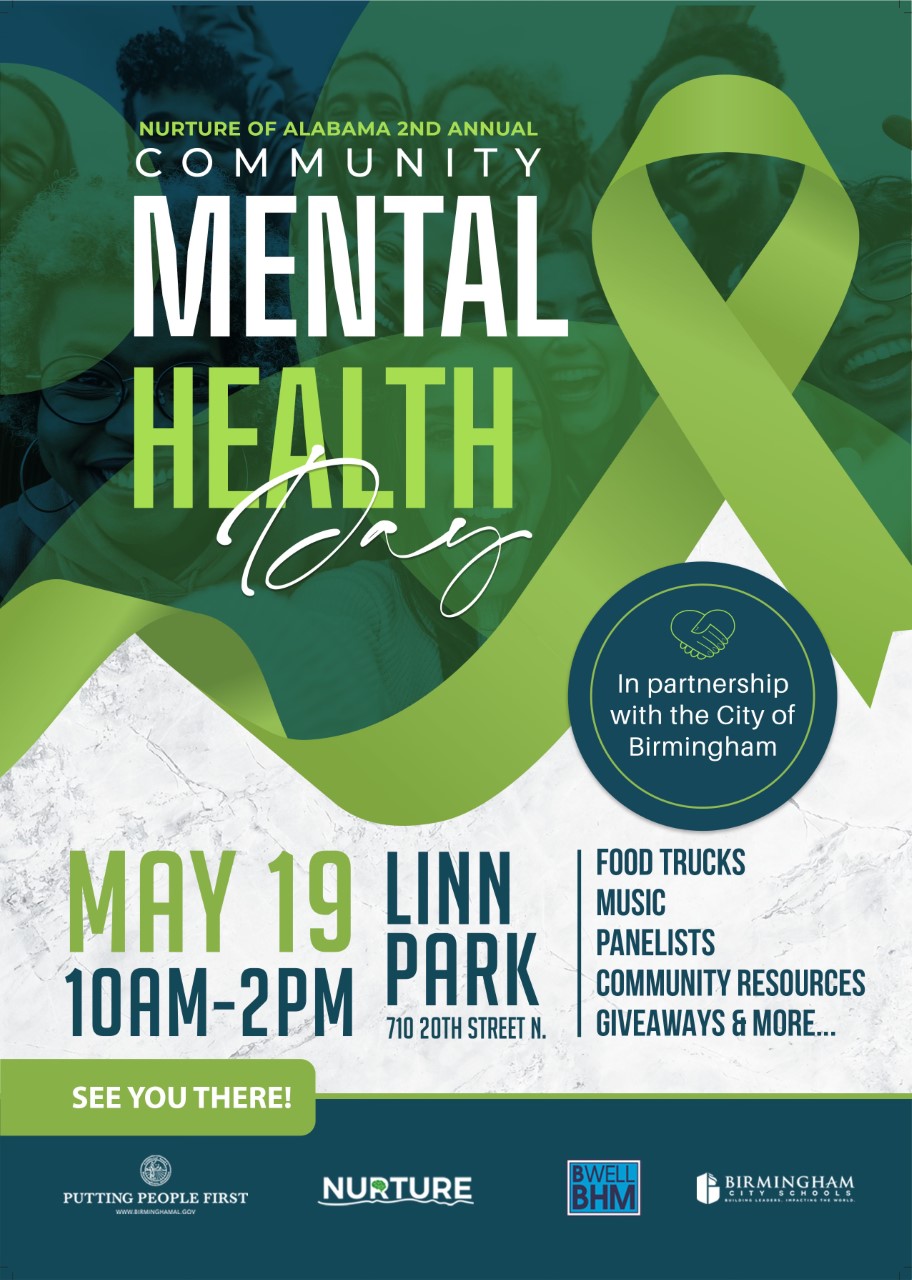
The City of Birmingham 2nd Annual Mental Health Day

By The PHAME-US Campaign

Join the PHAME-US.com and Wilkinson Wellness Lab team at this community event sponsored by Nuture, LLC, the City of Birmingham, AL and Birmingham City Schools. The event is free and open to the public.

Nurture of Alabama believes Birmingham can thrive, especially if communities address the mental health crisis experienced in our neighborhoods. Through the event Friday, May 19th, Nurture’s goals are to: 1) remove the stigma of mental health support, 2) improve mental health services accessibility, and 3) provide community education on mental health & wellness.

The event will have chair massages, a licensed professional counselor providing depression screenings, speakers,  free resources, giveaways, local food trucks,  yoga sessions, line dancing, blood pressure checks and more. So come out, have a good time, and let’s engage in mental wellness!

Supporting HBCUs to overcome historic underfunding

By Terrie Johnson | UAB Community Health & Human Services Intern

Photo by Ron Lach on Pexels.com

Historically Black Colleges and Universities (HBCUs) have a history in the United States of being underfunded due to varied underlying factors. One of the reasons may the history of systematic inequities. In other words, the discriminatory practices prevalent during the history of the United States, may still impact Black institutions today. Throughout the history of HBCUs, the principal mission has been to education the African American population. Since HBCUs have been tied to the Black population, they are often on the receiving end concerning limited funds allocation (Bagasra et al., 2022). Over time, this issue has caused chronic state underinvestment in HBCUs. Thus, such institutions continue to suffer from a lack of critical funds to run operations.

Additionally, lower alumni contribution is a factor in the continued underfunding of HBCUs. However, this issue is also linked to the socioeconomic position of many African-Americans within the United States. For example, most HBCU alumni earn less when compared to their White college graduate counterparts (Bagasra et al., 2022). This situation creates a gap in the level of contributions that Black alumni from HBCUs can make to advance the institutions. The amount of Black wealth in the United States is comparatively lower. As such, it cannot provide the needed funding to advance the functionality of HBCUs. The current situation in the country, whereby Blacks have limited economic opportunities, further perpetuates the financial circumstances of HBCUs (Bagasra et al., 2022).

Despite the financial pressures experienced by many HBCUs, can be increased through the adoption of critical best practices. For example, a public-private partnership can be encouraged to increase funding sources for institutions. The creation of greater awareness regarding this initiative will advance contributions toward the improvement of HBCUs (Jones et al., 2017). Moreover, greater advocacy for equity at the state and federal level can lead to changes in policies that provide greater support to HBCUs. Improved educational experiences may lead to advancements in African-American capital, which in turn would allow for alumni to give back to their HBCUs. This is why all African Americans should consider contacting (i.e., tweet, email, letters, phone calls, etc.) their state and federal representative and government leaders advocate for more HBCU funding. Check out this link for the United Negro College Fund (UNCF) to learn more and advocate. Share your advocacy story with us in the comments section or on Facebook.

References

Bagasra, A., McLetchie, A., & Wesley, J. (eds.). (2022). Contributions of historically black colleges and universities in the 21st century. IGI Global.

Jones, T., Jones, S., Elliot, K., Owens, L., Assalone, A., & Gándara, D. (2017). Outcomes based funding and race in higher education: Can equity be bought? Springer.

I am Not My Hair

By Tan Walker | Community Health and Human Services Intern

In today’s society, glorifying unhealthy and unrealistic expectations makes us beautiful. It is easy to focus on appearance rather than character. Women, especially black women, have to work more than most to attain the world’s idealistic view of beauty.

The Afro hair texture has been the epitome of a black woman’s life for centuries. As far back as the slave trade, Africans were forced to abandon their links and connections to their natural hair to simply strip away any cultural identity or tribal heritage (Black hair and an unjust society, 2021). However, this has not stopped Black women from embracing their natural tresses.

From the infamous “fro” to hair wraps to braids, Black women continue to embrace their natural hairstyles to help express who they are, and to show the evolution of empowerment and Black culture over time.

As a community, we must speak power into our young black girls and remind them that their natural hair is beautiful until they feel it themselves, and that their natural hair doesn’t define who they are. 

Black hair and an unjust society. (n.d.). Retrieved April 17, 2023, from https://www.edi.nih.gov/blog/communities/black-hair-and-unjust-society